top of page


What Are Research Peptides?
Advancing Scientific Discovery Through Peptide Research
Peptides have become an important area of modern laboratory research because of the many roles they play in biological systems. Scientists study peptides to better understand cellular communication, molecular pathways, metabolism, tissue processes, immune signaling, aging, and many other areas of biology.
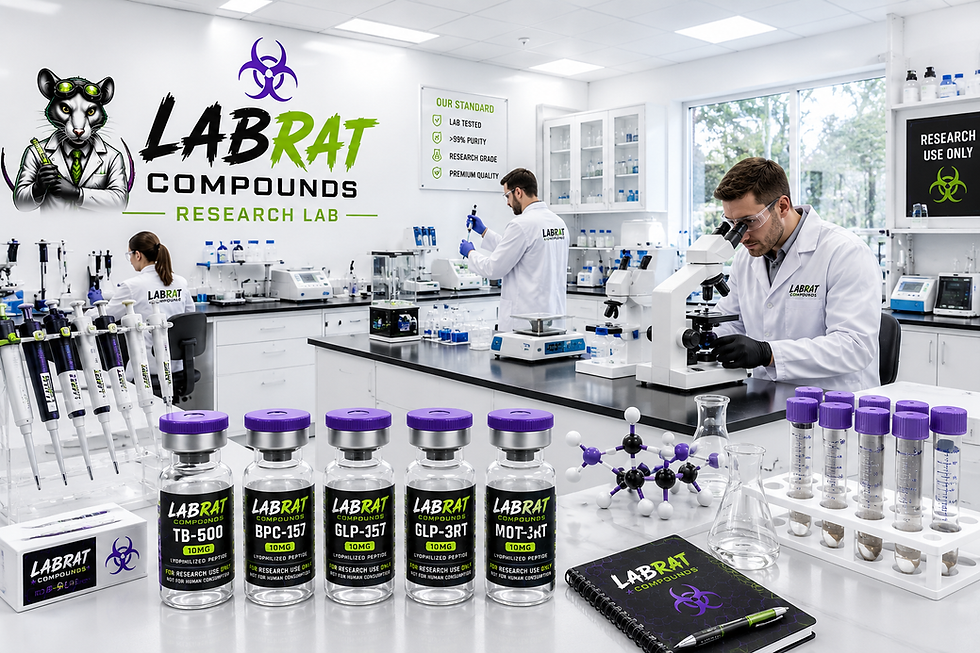
At LabRat Compounds, we provide research-grade peptide compounds intended exclusively for qualified laboratory, analytical, and educational research applications.
Our products are sold strictly for research use only and are not intended for human or veterinary use, consumption, injection, diagnosis, treatment, prevention, or cure of any disease or medical condition.
What Is a Peptide?
A peptide is a short chain of amino acids connected by chemical bonds known as peptide bonds. Amino acids are often described as the building blocks of proteins.
The primary difference between peptides and proteins is generally their size and structural complexity:
-
Peptides are shorter chains of amino acids.
-
Proteins are larger, more complex amino-acid structures.
Naturally occurring peptides are involved in many biological processes. Some function as signaling molecules, helping cells communicate and respond to changes in their environment. Because peptides can interact with specific biological pathways, researchers study them to better understand how those pathways function.
Why Are Peptides Important to Scientific Research?
Peptide research may help scientists investigate biological mechanisms at the molecular and cellular levels. Depending on the compound and study design, researchers may examine areas such as:
-
Cellular signaling and communication
-
Metabolic pathways
-
Energy regulation
-
Protein interactions
-
Tissue-repair mechanisms
-
Inflammatory signaling
-
Immune-system pathways
-
Neurological signaling
-
Hormone-related pathways
-
Skin and cellular-aging processes
-
Muscle and connective-tissue biology
Research findings may contribute to scientific knowledge and help researchers identify areas worthy of additional study. Laboratory findings do not automatically establish safety, effectiveness, or a benefit in humans.
How Does Peptide Research Benefit Science?
Research peptides serve as tools that allow scientists to study how specific molecular pathways operate. Controlled laboratory research may help researchers:
Improve understanding of biological systems
Peptides may be used to investigate how cells communicate and how biological pathways respond under controlled experimental conditions.
Explore molecular mechanisms
Researchers can examine how a peptide interacts with receptors, enzymes, proteins, cells, or other biological targets.
Support early-stage scientific discovery
Laboratory research may identify new questions, potential research directions, or biological mechanisms that deserve further investigation.
Develop analytical methods
Peptides may be used as reference or test materials when developing laboratory procedures involving identity, purity, stability, degradation, or molecular behavior.
Expand scientific knowledge
Even when research does not produce an expected result, properly conducted studies can provide useful information and contribute to a better understanding of biological processes.
What Does “Research Grade” Mean?
“Research grade” generally describes material intended for laboratory or analytical research rather than use as an approved medication, food, dietary supplement, cosmetic treatment, or consumer medical product.
Research-grade products may be evaluated using analytical testing methods to examine characteristics such as:
-
Identity
-
Purity
-
Molecular composition
-
Quantity or peptide content
-
Stability
-
Potential impurities
The term research grade does not mean FDA-approved, pharmaceutical grade, sterile, clinically proven, or approved for human use.
What Does Lyophilized Mean?
Many research peptides are supplied in a lyophilized, or freeze-dried, form.
Lyophilization is a process that removes moisture from a material under controlled conditions. This may improve stability during storage and transportation compared with maintaining the compound in a liquid solution.
The appearance of lyophilized material may vary. Differences in texture, density, shape, or position inside a vial do not necessarily determine purity or quality. Analytical laboratory testing is the appropriate method for evaluating a compound’s identity and purity.
Understanding Peptide Purity
Purity is the percentage of the tested material associated with the intended peptide relative to detected peptide-related components under a particular analytical method.
For example, a reported purity result greater than 99% generally indicates that the laboratory analysis measured a high proportion of the target peptide compared with detected peptide-related impurities.
Purity alone does not establish:
-
Safety
-
Sterility
-
Effectiveness
-
Suitability for human use
-
Correct vial quantity
-
Clinical benefit
Different laboratory tests measure different characteristics. A complete evaluation may require separate testing for identity, purity, quantity, sterility, endotoxins, or other specifications.
Why Is Independent Laboratory Testing Important?
Third-party analytical testing provides additional information about a research compound. Depending on the testing performed, a laboratory may evaluate:
-
Peptide identity
-
Purity
-
Molecular mass
-
Peptide quantity
-
Potential impurities
A Certificate of Analysis (COA) documents the results reported for the tested sample. Customers should review the COA carefully and verify that the sample or batch information corresponds with the applicable product.
Testing results apply to the sample submitted and the specific analyses performed. A COA should not be interpreted as proof that a product is approved, clinically effective, sterile, or suitable for human use unless those characteristics were specifically evaluated and documented.
Globally Sourced, USA Packaged and Independently Tested
Research-grade peptide raw materials are commonly produced through specialized international supply chains.
LabRat Compounds is committed to being transparent about our process. Our research materials are:
Globally Sourced • Packaged in the USA • Third-Party Lab Tested
We do not describe globally sourced raw peptide material as “USA manufactured.” Our focus is providing clearly labeled research materials supported by available analytical documentation.
Who Are Research Peptides Intended For?
LabRat Compounds products are intended for lawful laboratory, analytical, and educational research by qualified individuals and organizations with the appropriate knowledge, equipment, facilities, and procedures.
Potential research settings may include:
-
Independent laboratories
-
Universities and educational institutions
-
Biotechnology research
-
Analytical laboratories
-
Molecular and cellular research
-
Controlled in-vitro laboratory studies
Purchasers are responsible for understanding and following all applicable federal, state, and local laws, institutional requirements, laboratory procedures, and safety standards.
Research Use Only
All LabRat Compounds peptide products are sold exclusively for laboratory and research purposes.
Our research compounds are:
NOT FOR HUMAN OR VETERINARY USE
NOT FOR HUMAN CONSUMPTION
NOT FOR INJECTION OR SELF-ADMINISTRATION
NOT MEDICATIONS OR DIETARY SUPPLEMENTS
NOT INTENDED TO DIAGNOSE, TREAT, CURE, OR PREVENT ANY DISEASE
Product names, descriptions, research topics, laboratory findings, and published scientific literature are provided for educational and informational purposes only. They should not be interpreted as medical advice, dosing guidance, treatment recommendations, or claims of human benefit.
The Future of Peptide Research
Peptide science continues to grow as researchers investigate cellular communication, molecular interactions, metabolic signaling, tissue biology, and many other complex biological systems.
Careful laboratory research may improve scientific understanding and contribute to future discoveries. However, promising laboratory findings require additional research and should not be treated as proof of safety or effectiveness in people.
At LabRat Compounds, our goal is to support responsible research by providing clearly labeled research materials, transparent sourcing information, and accessible third-party analytical documentation.
LabRat Compounds
Research Driven. Quality Focused. Transparency Matters.
Globally Sourced • USA Packaged • Third-Party Lab Tested
For research use only. Not for human or veterinary use or consumption.
bottom of page